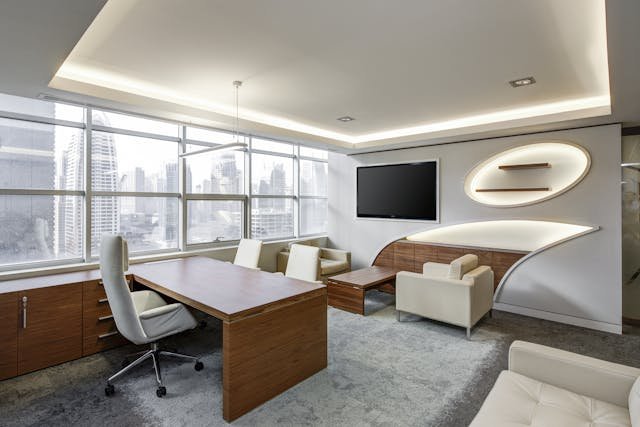
Office Space Calculator
Calculate your office space requirements efficiently
Basic Information
Additional Spaces
Space Calculation Results
Total Space Required
Space Recommendation
Based on your inputs, we’ll provide a space recommendation.
Office Space Planning Guide
Calculating the right office space is crucial for your business. Here’s what you need to know:
Standard Space Guidelines:
- Open Plan Workstation: 60-110 sq ft per person
- Executive Office: 150-300 sq ft per person
- Conference Room: 25-30 sq ft per person
- Reception Area: 100-200 sq ft for first 3-4 visitors
- Kitchen/Breakroom: 25-75 sq ft per person
- Utility/Storage: 50-200 sq ft depending on needs
Remember to account for common areas, hallways, and facilities when planning your office space. Most experts recommend adding 20-25% to your calculated space for circulation.
The Ultimate Guide to Office Space Calculation: How Much Space Your Business Really Needs
Introduction
Determining the right amount of office space for your business is both an art and a science. With commercial real estate costs representing one of the largest expenses for most companies, optimizing your office layout and square footage isn’t just about comfort—it’s about financial wisdom and operational efficiency. The average square footage per employee has evolved significantly over the past decade, with current standards ranging from 150 to 250 square feet per person depending on your industry and workspace configuration.
Why Office Space Calculation Matters
Office space planning directly impacts multiple aspects of your business:
Financial Implications
Commercial real estate typically represents the second-largest business expense after payroll. Overestimating your needs can waste precious capital, while underestimating can lead to costly relocations or expansions sooner than anticipated.
Employee Productivity
Well-designed spaces with appropriate density can increase productivity by 15-20%, while cramped or poorly arranged offices can have the opposite effect.
Operational Efficiency
Logical department arrangements and adequate common spaces improve workflow and collaboration.
Talent Attraction and Retention
Modern professionals expect comfortable, well-designed workspaces. In fact, 87% of employees consider office quality when deciding whether to join or stay with a company.
Scalability
Proper planning allows for organic growth without disruptive rearrangements or moves.
The shift toward hybrid work models has further complicated space planning, with many companies now needing to accommodate fluctuating daily attendance rather than 100% occupancy five days a week.
Key Factors in Office Space Calculation
Employee Headcount and Projected Growth
Your current and anticipated employee count forms the foundation of all space calculations. Industry experts recommend adding 10-20% to your calculated square footage to accommodate future growth without immediate expansion needs.
Office Layout and Density
High Density (80-150 sq. ft./employee): Characterized by open seating with minimal private offices
Average Density (150-250 sq. ft./employee): Mix of open areas and private offices
Spacious (250-500 sq. ft./employee): Primarily private offices, common in law firms and executive suites
Workstation Types
Open plan workstations: 60-110 sq. ft. per employee
Private offices: 90-400 sq. ft. depending on size and luxury level
Work group areas: 80-100 sq. ft. per employee
Common Areas and Special Spaces
Conference rooms typically require 50 square feet plus 25 square feet per person. Reception areas need 100-200 square feet per waiting person. Lunch and break rooms require 75 square feet plus 25 square feet per seated person. Halls and corridors typically account for 20-30% of total usable area. Additional spaces like mail rooms (125 sq. ft.), file rooms (200 sq. ft.), phone rooms (25-40 sq. ft.), and huddle rooms (50-80 sq. ft.) should also be factored into your calculations.
Departmental Considerations
Different departments have varying space needs. Executive teams typically require more private space, while sales departments often thrive in open environments with collaboration areas. Creative teams benefit from flexible spaces that can be reconfigured, and IT infrastructure may need dedicated server rooms or equipment areas.
Office Space Standards and Guidelines
While there’s no one-size-fits-all answer to office space calculation, industry standards provide helpful benchmarks. According to commercial real estate experts, the average office space per employee is approximately 196 square feet.
Research indicates that most experts recommend between 122 to 225 square feet per person, though this varies significantly by working style. For example, call center employees might need less space while sales professionals meeting with clients regularly might need more.
The 3-30-300 rule offers a helpful framework for understanding office costs: companies typically spend approximately $3 per square foot on utilities, $30 on rent, and $300 on payroll per square foot annually. This illustrates why optimizing space directly impacts your bottom line—every unnecessary square foot multiplies across these expense categories.
Industry-Specific Standards
Law firms typically require 250-500 square feet per person due to the need for private offices and client meeting spaces. Technology companies usually operate with 150-200 square feet per employee, favoring open collaborative environments. Call centers can function with 75-125 square feet per person as they utilize high-density seating arrangements. Creative agencies often need 175-250 square feet per person to accommodate both collaborative spaces and individual work areas.
Step-by-Step Office Space Calculation
Step 1: Determine Employee Headcount
List all current employees and projected hires for the next 2-3 years. Remember to account for different departmental needs and work arrangements (full-time in-office, hybrid, remote).
Step 2: Select Your Density Profile
Based on your company culture and operational needs, decide which density profile fits your organization. High density environments use 80-150 square feet per person, average density spaces allocate 150-250 square feet per person, while spacious offices provide 250-500 square feet per person.
Step 3: Calculate Workstation Requirements
Multiply your employee count by your chosen square footage per person. For a company with 50 employees opting for average density at 150 square feet per person, you would need 7,500 square feet for workstations alone.
Step 4: Add Common Areas
Calculate your common area needs based on your specific requirements. As a general rule, common spaces typically comprise 25-40% of your total office space.
Step 5: Account for Circulation
Add 20-30% for hallways, corridors, and other circulation spaces.
Step 6: Factor in Growth
Add 10-20% for future growth to avoid outgrowing your space prematurely.
Practical Example Calculation
Let’s calculate space needs for a 40-person company with average density requirements:
Workstations: 40 people × 200 sq. ft. = 8,000 sq. ft.
Common areas (30% of workstations): 8,000 × 0.3 = 2,400 sq. ft.
Subtotal: 8,000 + 2,400 = 10,400 sq. ft.
Circulation (25% of subtotal): 10,400 × 0.25 = 2,600 sq. ft.
Subtotal with circulation: 10,400 + 2,600 = 13,000 sq. ft.
Growth factor (15%): 13,000 × 0.15 = 1,950 sq. ft.
Total required: 13,000 + 1,950 = 14,950 sq. ft.
This calculation suggests our example company would need approximately 14,950 square feet of office space.
Special Considerations for Different Departments
Executive Areas
C-level executives and senior typically require larger private offices ranging from 150-400 square feet, often with adjacent administrative support areas.
Collaborative Spaces
Modern offices increasingly prioritize collaboration areas. Plan for conference rooms (1 per 10-20 employees), huddle rooms for small meetings of 2-4 people, team rooms for dedicated department collaboration, and informal collaboration areas like lounge seating and café areas.
Support Functions
Don’t forget to allocate space for IT server rooms (200-500+ sq. ft. if needed), storage areas (100-300+ sq. ft.), print/copy stations (50-100 sq. ft. each), and kitchen/break areas sized based on employee count.
Specialized Work Areas
Depending on your industry, you may need labs or testing facilities, production or studio spaces, client demonstration areas, or training rooms.
Future-Proofing Your Office Space
Hybrid work models have fundamentally changed space planning considerations. With employees spending fewer days in the office, many companies are adopting hot desking or office hoteling arrangements where employees reserve workspace as needed.
This approach can reduce your space requirements by 20-40% compared to traditional assigned seating models. However, it requires careful planning of support spaces and technology infrastructure.
When planning for future growth, consider flexible layouts that can be easily reconfigured, expansion options within your building, scalable infrastructure for technology needs, and modular furniture systems that can adapt to changing needs.
Research indicates approximately 52% of U.S. companies are planning to reduce their office space over the next three years to curb real estate expenses while adapting to new work patterns.
Common Mistakes in Office Space Planning
Underestimating Common Area Needs
Many companies focus primarily on workstations while underestimating the space needed for conference rooms, break areas, and collaboration spaces. This often results in cramped common areas that don’t function effectively.
Ignoring Circulation Space
Failing to account for hallways, corridors, and movement pathways can create bottleneck areas and reduce overall functionality.
Overlooking Technology Requirements
Modern offices require substantial technology infrastructure. Server rooms, wiring closets, and equipment areas are often forgotten until too late in the planning process.
Poor Departmental Arrangement
Placing departments without considering workflow and interaction patterns can reduce efficiency and collaboration.
Inadequate Growth Planning
Either planning too much space (wasting resources) or too little space (requiring premature expansion) are common mistakes.
Neglecting Hybrid Work Realities
Failing to adapt to new work patterns can result in underutilized spaces and inefficient layouts.
Frequently Asked Questions
How much office space per employee is recommended?
Most experts recommend 122-225 square feet per employee, with the average being approximately 196 square feet. However, this varies significantly based on your industry, office layout, and specific operational needs.
How do I calculate office space for multiple locations?
Calculate each location separately based on the specific employee count and space needs at each site. Remember that smaller satellite offices often require a higher percentage of common areas per person.
What is the minimum office space per person?
The absolute minimum for dense open plan arrangements is about 75 square feet per person, though this is only suitable for specific environments like call centers with minimal movement and storage needs.
How much space should I allocate for conference rooms?
Plan for approximately 50 square feet plus 25 square feet per seated person for conference rooms. Most companies need one conference room for every 10-20 employees, depending on their collaboration needs.
How does hybrid work affect office space needs?
Hybrid work typically reduces space needs by 20-40% as employees share workspaces on different days. However, this may be offset by increased need for collaboration spaces when employees are in the office.
What percentage of office space should be dedicated to common areas?
Common areas typically comprise 25-40% of total office space, depending on your company’s collaboration culture and density approach.
How far in advance should I plan for office expansion?
Most experts recommend planning for 2-3 years of growth when signing a lease. Adding 10-20% to your calculated space needs is a common approach to accommodate growth.
What’s the difference between usable square footage and rentable square footage?
Usable square footage is the space you actually occupy, while rentable square footage includes your proportional share of building common areas (lobbies, restrooms, etc.). Rentable square footage is typically 15-30% higher than usable square footage.
How much space do I need for 50 employees?
For 50 employees with average space requirements, you would need approximately 10,000-12,500 square feet, including workstations, common areas, and circulation space.
Can I reduce office space with hot desking?
Yes, hot desking or office hoteling can reduce space needs by 20-40% by allowing employees to share workspaces on different days rather than each having assigned seating.
Conclusion
Calculating your office space requirements is a critical business decision that balances immediate needs with future growth, employee experience with financial constraints, and operational efficiency with flexibility. While the average of 150-250 square feet per employee provides a helpful starting point, your specific needs will depend on your industry, work styles, and company culture.
The most successful office space plans incorporate flexibility for changing needs, accommodate both focused work and collaboration, and support your company’s cultural values. As hybrid work continues to evolve, successful companies will increasingly focus on creating purpose-built spaces that employees choose to come to for specific activities rather than simply default workspaces.
Remember that these calculations provide estimates rather than definitive answers. For precise planning, consult with commercial real estate professionals and interior designers who can help you optimize your specific space for your unique needs.
Disclaimer
The information provided in this article is for general informational purposes only and does not constitute professional advice. Office space requirements vary significantly based on specific business needs, industry standards, and local building codes. While we strive to provide accurate and up-to-date information, we recommend consulting with qualified commercial real estate professionals, architects, or space planning specialists before making decisions about your office space. The author and publisher disclaim any liability for any damages or losses resulting from reliance on the information provided herein.
Our Top Picks-Explore & Enjoy
If you enjoyed this post, we’ve hand-picked my favorite, tried-and-true recommendations for Relationships, Pet care, Travel, evidence-backed wellness,and much more. Go to your relevant niche below and start improving love, health, and pet happiness today.
Travel ✈️🛣️
Travel smarter, not harder. Why spend hours scouring the web to piece your trip together? I use a one-stop-shop for scoring the best prices on everything from rental cars and flights to all-inclusive resorts. It’s my secret for turning travel dreams into reality without blowing the budget. Explore here
Beauty & Health 🌿⚕️
Cut through the hype and find supplements and everyday wellness tools that deliver. Discover how to read labels, select high-quality products, and incorporate them into simple habits for lasting results. Find here
Pets 🐶🐱
From leash manners and crate comfort to picky-eater solutions and seasonal care — learn straightforward training techniques and simple nutrition tips that prevent problems and boost wellbeing. Practical advice every pet parent can follow. click here
Relationship❤️💕
Feeling distant from your partner? Discover practical conversation starters, small daily rituals, and conflict tools that help restore trust and warmth. No jargon — just realistic steps you can start using today.click here
Be on-line🛜💻
For Bloggers and writers—-Boost your website’s performance with ultra-fast servers, 24/7 expert support, and a beginner-friendly control panel—all at unbeatable prices. Whether you’re launching a blog, online store, or portfolio, it makes it effortless to get online and scale as you grow. Ready to level up? 👉 Grab your exclusive deal here!